
VARIOUS WAYS TO MOVE INTO AN OPPONENT
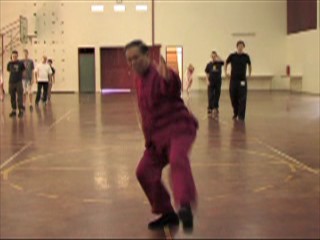
Grandmaster Wong demonstrating the "Shoot-Step" during the Sabah Intensive Shaolin Kungfu Course
Moving into an opponent effectively requires suitable techniques and appropriate skills. More importantly, you have to ensure you are safe from his counter-attacks.
If all things were equal, the responder has an advantage over the initiator in an encounter. In the process of your attack, as you move in and before you have stabilized yourself is the moment when you are vulnerable to an opponent's counter-attack. For example, as your front foot reaches the ground and you are about to thrust out a punch, if your opponent's snake palm is coming at your eyes or throat, or his kick coming at your ribs, it is not easy to defend against his surprised counters if you are not prepared and trained to do so.
Reversely, if an opponent rushes in to attack you, it is relatively easy for you to strike him in surprise, especially if he is not trained in the principle of “safety first” and thus exposes himself carelessly. Please see Surprise your Attacker with a Counter-Attack.
The Importance of Footwork
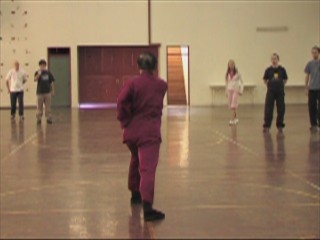
A common mistake some students make especially in Combat Sequences 1 to 4 is not to move their front leg sufficiently from Bow-Arrow to False-Leg or vice versa. Hence the tactics of “shallow” and “shoot” is not effective. It is also important to rotate the waist.
Moving into Attack with Correct Spacing
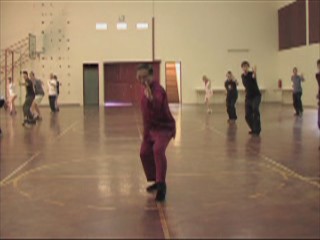
Here are moving one step and moving one and a half steps to attack. Asking the way is essential. It is one of the secrets that ensure “safety first”. “Black Tiger” is executed by rotating the waist with internal force issuing from the dan tian and exploding in the punch. This is another secret, and it concerns internal force.
Left-Leg Mode to Left-Leg Mode
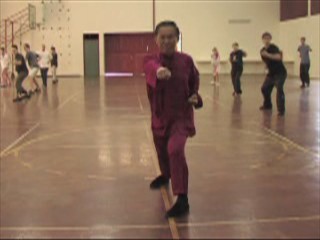
You can move in to attack your opponent from left-leg mode to left-leg mode. You start with your left leg in front, and end also with your left leg in front, though you have changed from a False-Leg Stance to a Bow-Arrow Stance. Another mode would be used if, for some technical considerations, you wish to have your right leg in front.
The Shoot Step
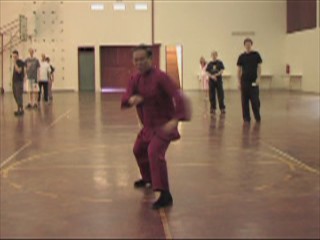
Here is the “Shoot Step”, or “Phiew Pou” (Cantonese) in Chinese, in your opponent is far away. It involves three different stances, namely False-Leg, Unicorn and Bow-Arrow, but is performed in one smooth movement.
The Three-Step Shoot
If your opponent is further away, or if you wish to press in further, you can use a three-step shoot shown here, instead of the two-step shoot shown in the previous video clip. In the three-step shoot, you start by moving your front leg from False-Leg to Bow-Arrow, whereas in the two-step shoot you start by moving your back leg from False-leg to Unicorn.
Shoot and Roll in Four-Step Attack
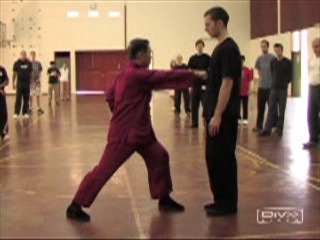
Grandmaster Wong illustrates various ways of moving in to attack depending on how far away your opponent is. If he is four steps away, you could use a three-step shoot plus a roll-step. These two movements — shoot and roll — should be performed as one smooth movement. Notice that the movement is from left-leg mode to left-leg mode.
LINKS
Review of the Intensive Shaolin Kungfu Course in Sabah in March 2007
- Overview 1 : The Fundamentals
- Overview 2 : The 16 Combat Sequences
- Overview 3 : Are They Performing Kungfu Dance?
- The Basics of Shaolin Kungfu Training
- Fundamental Combat Skills
- Defeat you Hand to your Opponent, Victory you Create Yourself
- Avoiding Disadvantages and Seeking Advantages
- Basic Principles and Tactics of Combat
- Skills derived from Sparring can be Rewardingly used in Daily Life
- Some Secrets in Practicing Genuine Kungfu
-
Various Ways to Move into an Opponent
- Applying Combat Sequences in Sparring
- Linking Sequences to be More Combat Efficient
- The Secrets of Continuous Cannons
- The Mechanics of Continuation
- Marvelous Techniques Beget Marvelous Techniques
- Perfecting Forms and Developing Force
- Applying Tactics in Combat
-
Objectives of Form Training in Solo
- Being Fluent in Kicking Techniques before Applying them in Combat
- Using Tactics in Kicking Attacks and Defences
- Different Levels of Sophistication in Sparring and Fighting
- The Legacy of Uncle Righteousness: Secret of Continuous Cannons and their Counters
-
Benefiting from the Experiences and Teachings of Past Masters
- Poetic Patterns Can be Very Deadly
- Moving Back One Step when in Diffiuclt Situations
- Linking Sequences to Form a Kungfu Set
- Felling Techniques in Kungfu are Different from Judo and Wrestling
- Butterfly Palms and Hiding Flowers are Excellent in Countering Felling and Gripping Attacks
-
Let Mercy Flow from the Hands
- Benefits of Solo Set Practice — Combat Sequences 13 to 16
- From Pre-Choice Sequences to Free Sparring
- Applying Shaolin Patterns Correctly and Spontaneously in Free Sparring
- Shaolin Kungfu against Boxing and Kick-Boxing
- Shaolin Counters against Wrestling Shoots
- The Secret of Grandmaster Ho Fatt Nam
- Why Shaolin Kungfu is Technically Faster than Boxing
- Shaolin Techniques, Tactics and Strategies against Boxing
- Revealing Secrets of Past Taijiquan Masters
- Overwhelming Opponents with Just One Pattern
- Poetry and Elegance in Effective Combat