
PICTURE-PERFECT FORMS AND FLOWING MOVEMENTS
 "Black Tiger Steals Heart"
Have you wondered why we attack and defend in particular ways, like using “Black Tiger Steals Heart” and “Single Tiger Emerges from Cave”, and not punch and block randomly? It is because these particular ways of fighting, called patterns, give us the best advantages in given combat situations.
Early fighters fought randomly, not unlike most untrained persons do today. Those who fought regularly and frequently discovered from direct experience that certain ways of fighting, like striking in a particular manner and moving in a particular fashion, gave them various advantages. Over many centuries these particular ways of fighting evolved into formalized patterns.
Later, kungfu masters linked various patterns into sequences, and sequences into sets. Such developments over many centuries were possible when fighting was taught as an institutionalized art as in the Shaolin Monastery, not as personal abilities. In other words, when a Shaolin master taught his students, his instructional material was not taken from his personal experience, but from the collective effort of thousands of masters over many centuries. This is different from what an individual fighter teaches his students. His instructional material consists of his own experience, including what he has seen and heard, and not the vast repertoire of an institution.
Besides practical material, an institutionalized art also contains extensive and profound philosophy. For example, from kungfu philosophy we know that although attacks can come in countless forms, they all can be generalized into four main categories, namely striking, kicking, felling and gripping. Hence, to be combat efficient, we need to be proficient in dealing with all these four categories of attack. Surprising it may be, many martial arts today are incomplete, focusing on one or two of these categories and having no techniques to defend against attacks from the other categories. This is mainly because such martial arts are actually meant to be sports where dangerous attacks are forbidden.
Understanding such philosophy enables our learning and training to be cost-effective. For example, by practicing defences against typical attacks, we may be able to defend against all attacks. This is more cost-effective than learning a lot of defences in isolation. In principle, it is like learning how to type, then you can type any document, instead of learning to type a lot of documents one at a time.
First we deal with only one type of attack, i.e. striking. Other types of attack will be dealt with later. Strikes can come in from countless directions, but they can be generalized into four main directions, namely top, middle, bottom and sides. When you can defend against these four directions of strikes, you can defend against all strikes!
But in this section we learn to get the forms correct. Their combat application will be learnt later.
Note the co-ordination of footwork, body-movement and hand technique, which constitutes the “three external harmonies”. The weight is on the back leg, turn the body by rotating the waist, and punch in a spiral movement. The legs, body and fist should “arrive” at the same time. The sound “herit” comes from the dan tian. The mouth must be open as the punch is executed.
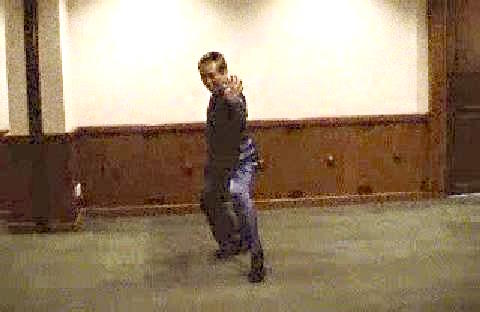 Single Tiger Emerges from Cave
“Single Tiger Emerges from Cave” is not a block; this technique is called “leaning”, i.e. you lean your arm on the opponent's. The attack will not reach you even if you do not move your hands at all as you have moved your body away by sinking into the False-Leg Stance. The sound “yaaah” comes from the lungs. Make sure it does not come from your throat.
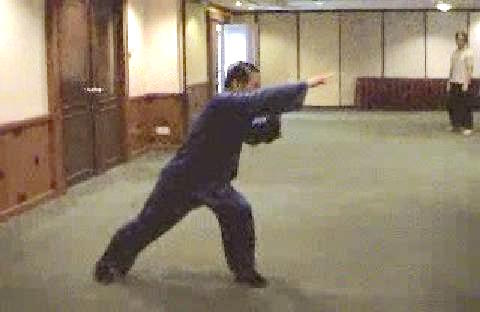
The movement of the finger-thrust, like that of the punch in “Black Tiger”, starts from the back foot, and is implemented by the rotation of the waist. The force comes from the dan tian. The “ssssh” sound comes from the kidneys.
 Golden Dragon Plays with Water
This is a beautiful pattern that uses minimum force against maximum strength. It is not a block. The technique is called “threading”, i.e. you move your hand as if you are sewing with needle and thread. The hand movement is led by the fingers, not by the forearm, and you lean slightly forward.
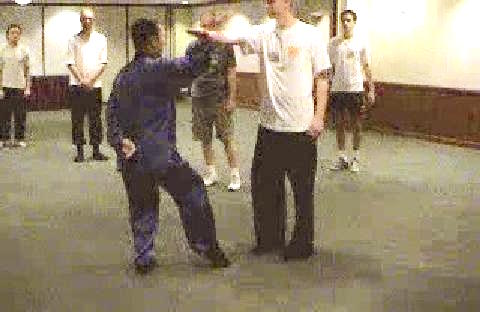
The “threading” technique is meant to deflect, not block, an on-coming attack. As the attack approaches, you simply “thread” your hand forward. This is different from blocking where you bounce the attack back. Your body is slanted slightly to further move the target away from the attack.
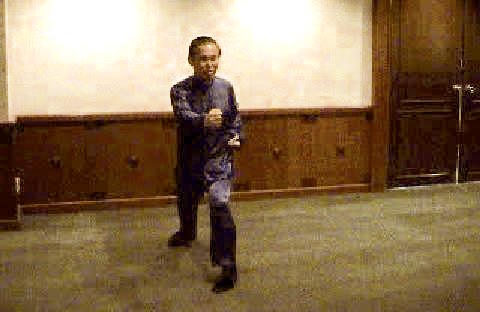
Some people have heard the kungfu principle that the movement of an attack comes from the waist, but do not really know what this means. The movement is generated by the rotation of the waist. The waist rotation expedites the explosion of internal force from the dan tian to the strike.
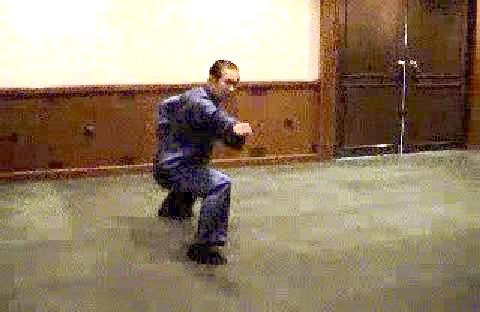
The term “whole body movement” is sometimes heard but little understood. “Whole body movement” means that your whole body is in motion even when you use just your hand to strike so that your internal force is focused on this one strike, as in the pattern “Precious Duck Swims through Lotus” shown here.
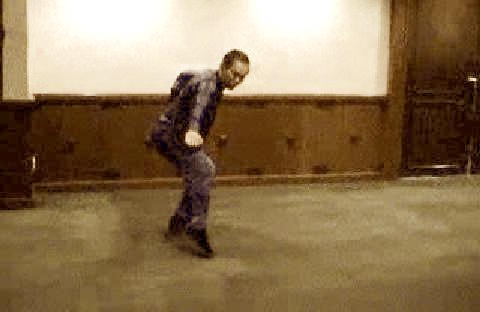
The point of contact with an opponent's attack is not your forearm but the edge of your palm. Your sweep may dislocate or fracture an opponent's arm as he completes his attack, employing the tactic “no defence direct counter”.
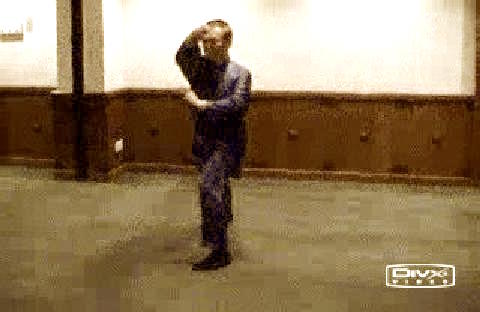 Hang a Golden Star at a Corner
In swinging a “horn-punch” your arm should act like a chain, and not a rod. The punch is swung beyond the target, usually an opponent's temple, but in practice with a sparring partner you should stop a few inches before target in case he may fail to defend.
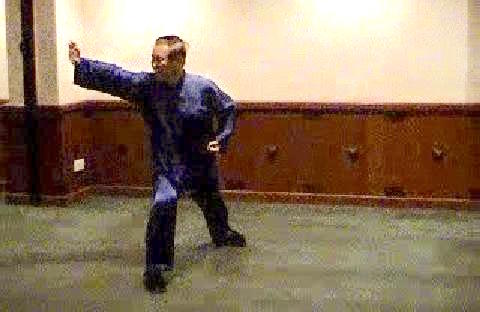 Slight Difference, Big Difference
A slight difference in performing this pattern against a swinging horn-punch may give a big difference in result. If you perform this pattern as a block, a mistake commonly made by many people, your arm may be broken. If you perform it correctly as an interception, you may break an opponent's arm. This pattern is called “Immortal Emerges from Cave”.
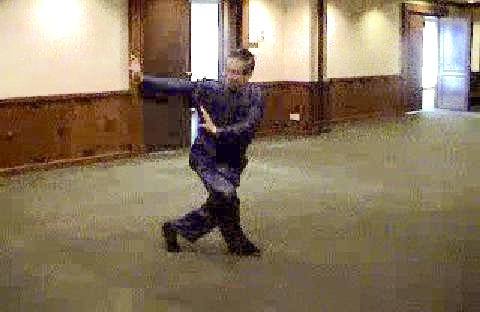
You can now have some fun composing your own kungfu set. You may perform various patterns moving about in different hand-orms and stances. You may, for a start, choose patterns from "Lohan Asks the Way".
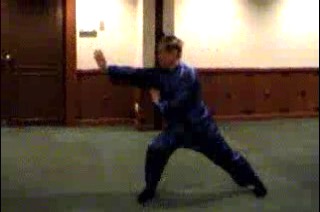
You may like to try what you have learned. You can moved forward or backward or in any direction with stepping forward, stepping backward, rolling forward or dragging backward.
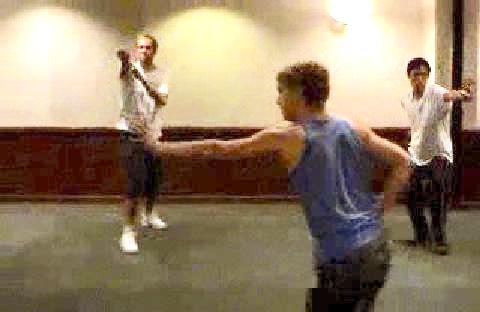 Selecting Patterns in Different Order
You need not use all the patterns or follow the same sequence. You may select just two or three patterns, and perform them in any order.
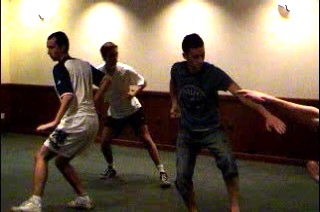 Picture-Perfect Forms and Flowing Movements
Participants have a lot of fun and benefit linking various patterns together and performing them in sequences. It is inspiring that their forms are picture-perfect and their movements fluid.
Picture-Perfect Forms and Flowing Movements from Wong Kiew Kit on Vimeo.
1. Stances: the Foundation for Internal Force and Combat Efficiency
2. Footwork Secrets for Health, Efficiency and Elegance
3. Moving into a Same Direction using Different Ways to Gain Advantages
4. Picture-Perfect Forms and Flowing Movements
5. From Random Fighting to Patterns, and from Patterns to Sequences and Sets
6. One-Step Sparring to Develop Combat Skills
7. From Pre-Arranged Sparring to Guided Sparring
8. Using Techniques and Tactics in Sparring
9. The Five Basic Kicks
10. The Secrets of Side Kicks and Continuous Cannons
11. How You may Defeat Opponents Experienced in Random Free Sparring
12. How Would a Fragile Girl Counter a Powerful Sweeping Kick from a Muay Thai Fighter?
13. Shaolin Felling Techniques and their Defences
14. Safety First Before Executing Felling Techniques
15. From Combat Sequences to Free Sparring
16. Sixteen Combat Sequences and Five Kungfu Sets
17. Surprise your Attacker with a Counter-Attack
18. Working out Ways to Fight a Boxer
19. Effective Tactics and Techniques against Boxers
20. From Gross Outline to Fine Details
21. Exploiting Advantage to Clinch Victory
22. Variety of Kungfu Techniques against Boxers
23. Analysis of Techniques Used against Boxers
24. Using Shaolin Kunfu against Boxing in Free Sparring
25. Effective Shaolin Tactics and Techniques against Kick-Boxing
26. Shaolin Kungfu against Kick-Boxing in Free Sparring
27. How to Handle a Karate Exponent
28. How to Handle a Taekwondo Exponent
29. How to Handle a Wrestling Exponent
30. Understanding the Typical Attacks of Muay Thai Fighters
31. Grandmaster Ho's Secrets in Countering Muay Thai Fighters
32. First Avoid Defeat, Then Secure Victory
33. Counteroing the Elbow and Knee Attacks of Muay Thai Fighters