
COMBAT SEQUENCE 3: PRESSING ATTACKS AND HOW TO DEFEND AGAINST THEM

Combat Sequences 1 and 2 cover the four major categories of strikes, namely top, middle, bottom and sides. Sequence 3 introduces the tactic of pressing attacks and how to defend against them. This video series shows step by step how the combat sequence is developed, why the particular patterns were used and the combat principles underlying them.
Besides hand-techniques, footwork and body-movement are very important in realizing intended combat objectives. An effective co-ordination of footwork, body-movement and hand-techniques constitutes the “three external harmonies”. The “three internal harmonies” are those of “jing”, “qi” and “shen”, which are essence, energy and mind.
In Sequences 1 and 2 shown in the earlier series, the footwork code is “left-right, left-right”, which means that the initiator starts with his left leg in front at his poise pattern, and moves forward to attack with his right leg in front. The responder poses with his left leg in front, and responds by moving into a stance with his right leg in front in his defence or counter.
In Sequences 3 here, the footwork code is “left-left, right-right”. The initiator poses with his left leg in front, and moves his front left leg forward using a roll-step to attack. The responder poses with his right leg in front, and responds in a right stance. Employing different modes of footwork in attack and defence gives certain advantages.
Attacking by Retreating
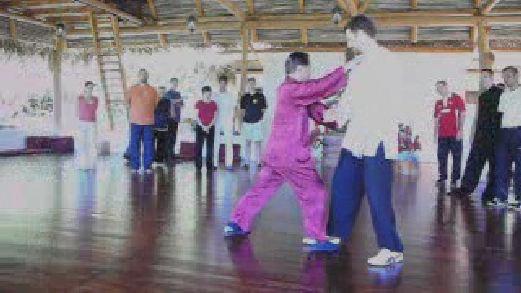
The responder moves his back left foot backward, deflects, then moves his body forward without moving his legs to counter-attack. This is an example of “attacking by retreating”.
Attacking Footwork using Left-Left Mode
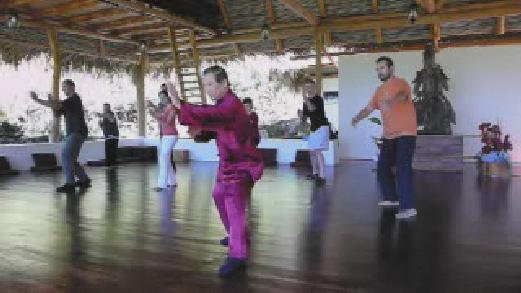
This is moving in to attack using the left-left mode for long, medium and short ranges.
Flowing with the Opponent to Attack

The initiator initiates an attack for the responder to respond, then flows with the response with another attack.
Defence against Flowing-in Attack

The above combat situation is reversed to demonstrate how to defend against a flowing-in attack. Note the effective use of body-movement.
Continuous Attacks
Here is an example of continuous attacks. In a flowing-in attack, you wait for an opponent to counter-attack, then you deflect his counter-attack and attack again. In a continuous attack, you continue a second attack before the opponent counters
Three Types of Attacks
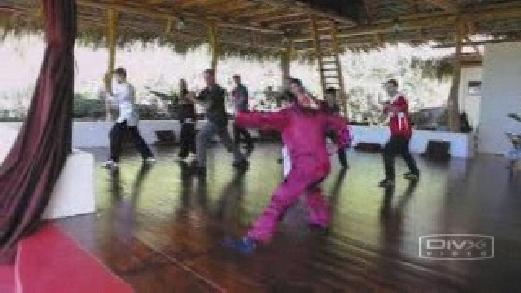
The three types of attacked are demonstrated. These three types of attacks are an intial attack, a flowing-in attack and a continuous attack.
Counter against a Triple Attack
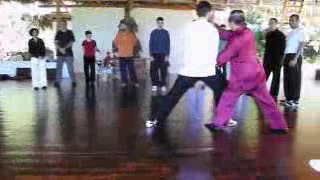
Here is how to counter a pressing triple attack.
Breaking an Opponent's Pressing Attacks

This is the structure showing the counters against an opponent's pressing triple attacks. Footwork and body-movement are effectively used to “break” the opponent's pressing attacks.
Intercepting an Opponent's Attack

The role is reversed to show how to intercept an opponent's counter-attack using effective body-work.
Pressing through an Interception
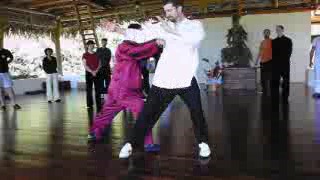
Although the opponent is caught off-guard the first time, he can successfully neutralize your attack the second time, indicating immediately benefited from the lesson.
Structure of Pressing Attacks and Defences
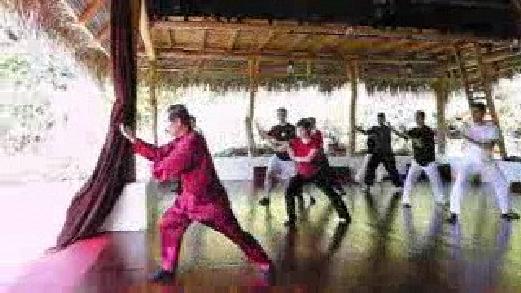
The initiator's mode of Sequence 3 is performed pattern by pattern, and then in a sequence, to show the structure of pressing attacks and their defences.
Spontaneous Sparring

Within the framework of the first three sequences, participants spar spontaneously, without knowing what patterns their sparring partners would use next. It is inspiring to note that fresh beginners could use Taijiquan patterns reasonably well in the sparring.
Combat Sequence 3 -- Pressing Attacks and How to Defend against Them from Wong Kiew Kit on Vimeo.
LINKS
Wahnam Taijiquan Training from Basics to Free Sparring
- Part 1 — The Secret of the Internal Force Masters
- Part 2 — Cloud Hands: From Chi Flow Movements to Patterns and Sets
- Part 3 — Developing Combat Skills in Pushing Hands
- Part 4 — Practicing Combat Techniques in Striking Hands
- Part 5 — Applying Kicks, Throws and Grips in Striking Hands
- Part 6 — Combat Sequences 1 and 2: Top, Middle, Bottom and Sides
- Part 7 — Combat Sequence 3: Pressing Attacks and How to Defend against Them
- Part 8 — Combat Sequences 4 and 5: Thrust Kick, Side Kick and Whirlwind Kick
- Part 9 — Combat Sequence 6: Felling Opponents with Carrying Tiger Back to Mountain
- Part 10 — Combat Seqeences 7 and 8: Chin-Na or Gripping Attacks and their Defences
- Part 11 — The Eight Simplified Combat Sequences of Wahnam Taijiquan
- Part 12 — From Guided Sparring to Free Sparring in Wahnam Taijiquan