MISCELLANEOUS TECHNIQUES, COMBAT SEQUENCES AND COMBINATION SETS
Senior Students of Sifu Wong engaged in sparring practice
Combat efficiency is an important aspect of kungfu, any styles of kungfu, including Taijiquan of course. Unfortunately most kungfu practitioners today cannot apply their kungfu for combat. Most of them merely perform kungfu forms, beautiful the forms may be.
Going from solo form practice to free sparring is a sure way to spar haphazardly or like children. A systematic sparring methodology is necessary.
In Shaolin Wahnam, practicing miscellaneos techniques, combat sequences and combination sets is an important link between solo form practice and free sparring. Some of the video clips show training methods used in Shaolin Wahnam more than 20 years ago.
Please click on the pictures or their captions to view the videos
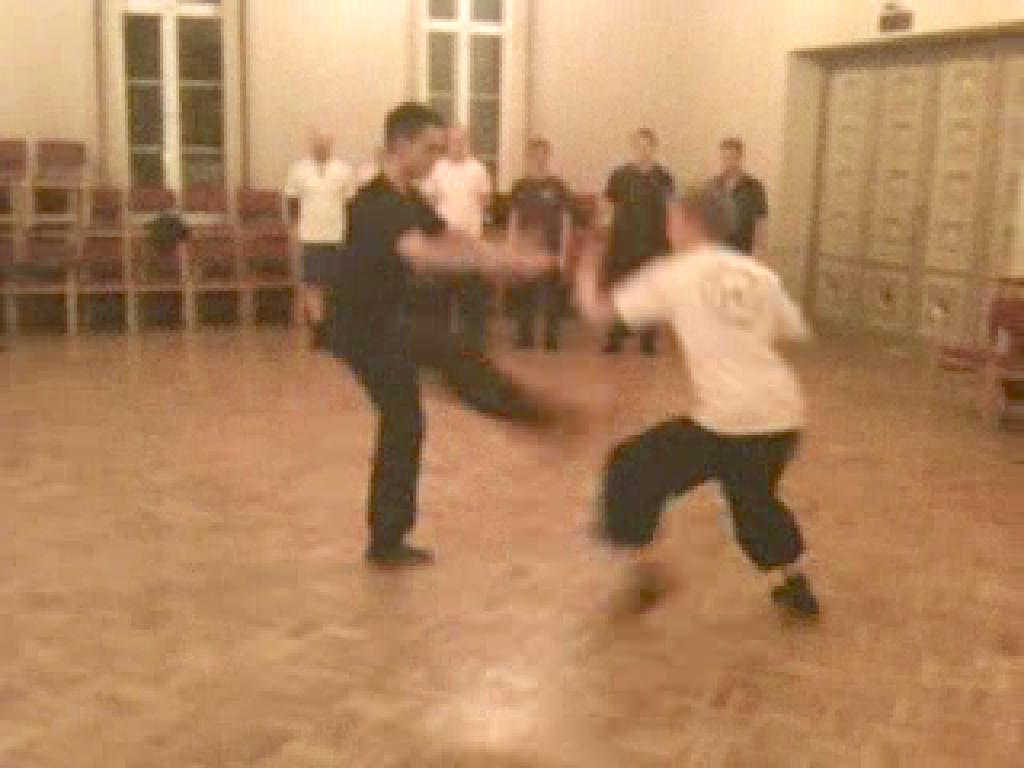 Taming-Tiger Combination Set
A combination set is a set where two or more practitioners perform a long series of pre-arranged sparring movements. Here Max from England and Jani from Finland perform the Taming-Tiger Combination Set.
Click here to enter.
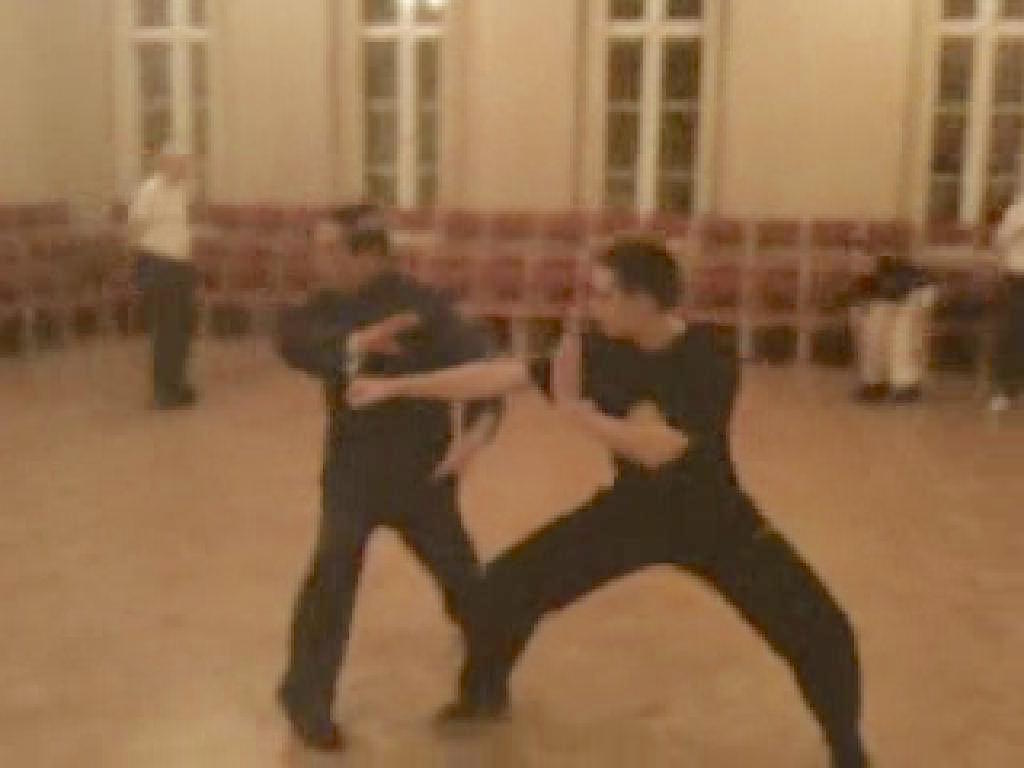 Glimpses of Combat Applications from Taming-Tiger
The Shaolin Taming-Tiger Set contains many sophisticated combat applications. The video clips here show some impromptu demonstrations by Grandmaster Wong as he taught the class this Taming-Tiger Set at the First Winter Camp at Helsinki, Finland from 25th to 29th January 2020.
Click here to enter.
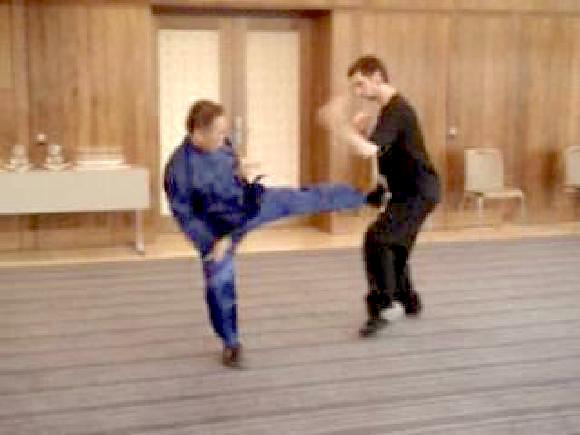 Four Abridged Shaolin Combat Sequences
The Four Abridged Shaolin Combat Sequences are excellent in helping students to apply Shaolin techniques in combat. These sequences are abridged from the Eight Distilled Combat Sequences, which are in turn distilled from the Sixteen Basic Combat Sequences.
These sequences have been taught by Grandmaster Wong with some variations at various regional Shaolin Kungfu courses in Japan, Portugal, Spain, the United States and Ireland. They are now standardized and presented below. The original version first taught in Japan in December 2007 is also presented below for comparison.
Click here to enter.
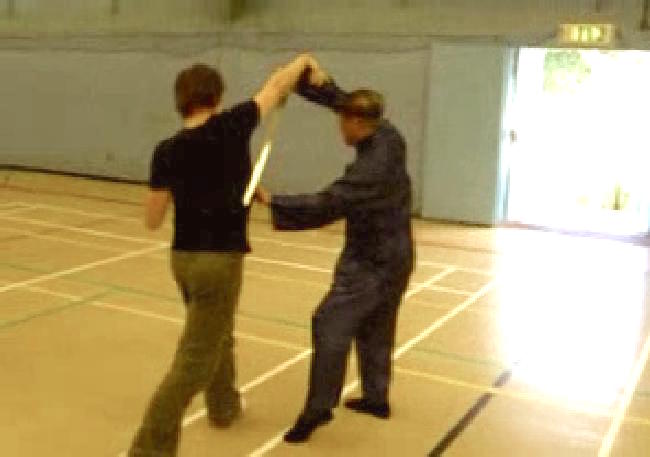 A Gentle Touch of Dim-Mark
Dim-mark is a highly sophisticated skill of dotting an opponent's vital point to immobilize or injure him. It is actually a compassionate way of fighting, as the injury can be rectified. A master executing dim-mark may just touch an opponent gently.
An unexpected but amazing demonstration of dim-mark occurred at the 2007 UK Summer Camp Weapon Course. Grandmaster Wong showed how a swordsman could apply the pattern "Immortal Points the Way" to release an opponent's grip on his wrist and simultaneously dot his vital point.
Click here to enter.
 Fundamental Movements in Taijiquan
Many Taijiquan practitioners have heard of the expression "movement from the waist", but few really know how this principle is put into practice. The video clips in the first section show how you can, and should, perform Taijiquan with movement from the waist. This waist-movement principle is crucial in attaining the three external harmonies of feet, body and hands.
With the three internal harmonies of "jing", "qi" and "shen", which are "elegance of movement", "energy flow" and "presence of mind", they form the six harmonies, which should be applied in every pattern you perform, thus making Taijiquan alive. The various patterns, shown in the video clips in the second section, are linked into a set called "White Crane Flaps Wings".
Click here to enter.
 Pushing Hands and Striking Hands
"Pushing Hands" or "Tui Shou" is a very important aspect of Taijiquan, as it develops basic combat skills. But many Taiji practitioners today neglect this training. Another important fact many Taiji practitioners do not realize is that "Tui Shou" by itself is insufficient to enable them to be combat efficient. They also need to practice "Da Shou" or "Striking Hands".
"Striking Hands" is not confined only to strikes but also include the other categories of attacks, namely kicks, felling attacks and chin-na. Nevertheless, kicking, felling and chin-na are shown in subsequent series. This series shows striking attacks, which form the first of our four abridged Taijiquan combat sequences.
Click here to enter.
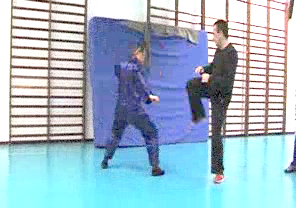 Kicks and Felling Techniques in Sequence Sparring
This series of video clips show the lessons where the abridged Combat Sequences 2 and 3 are learnt. These sequences concern kicking and felling. Students learn how to employ the tactic of pressing attacks on an opponent.
One effective counter against pressing attacks is to kick as an opponent presses in. An excellent defence against any kicks is "Striking Tiger Poise". The pattern "Carry Tiger Back to Mountain" is used to fell and opponent in Sequence 3. The counter is "Breeze Sways Lotus Leaves", which is a whirlwind kick. All the three combat sequences learnt are then reviewed in solo practice.
Click here to enter.
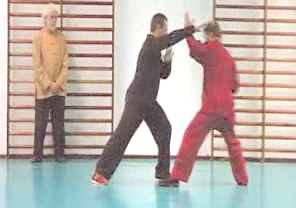 Elegance and Flow in Taijiquan Combat
"Defence cum Couner" or "lian xiao dai da" in Chinese (Mandarin) is a very important combat tactic in Taijiquan. Using this tactic, a skillful Taijiquan practitioner may strike an opponent before the latter realizes what has happened.
This tactic is incorporated in Sequence 4 which involves chin-na techniques. Taijiquan is well known for being elegant and flowing, yet very powerful. This aspect is highlighted in the videos. And in conclusion, all the four abridge combat sequences are reviewed.
Click here to enter.
Please click on the pictures or their captions to view the videos
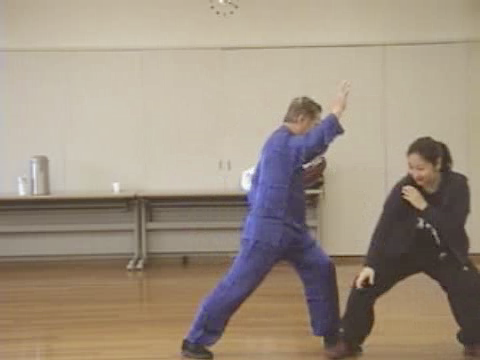 The Basics
We are very proud of our students, especially those who learned kungfu the first time, at the Introductory Shaolin Kungfu Course held in Japan from 16th to 18th December 2007. They achieved in three days what many other people may not achieve in five years!
What makes us very pleased with our result is our spiritual cultivation. As it is evident in the video clips shown in this series, our students are happy and relaxed even when sparring, and they help one another to progress. Today many other kungfu practitioners are angry and stressful, and hurt one another even in friendly sparring.
Click here to enter.
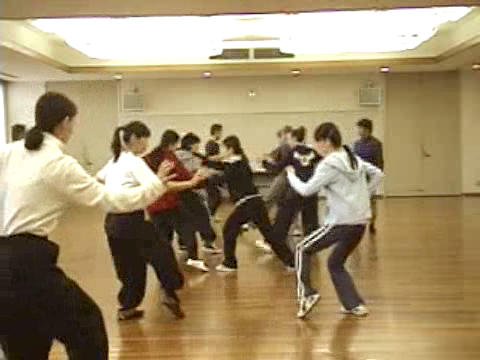 From Solo Patterns to Sequence Sparring
Many kungfu practitioners today cannot use their kungfu patterns for free combat. We are proud that our students, including fresh beginners, at the Introductory Shaolin Kungfu Course overcame this big problem.
On the first day of the course, they spent much time training the basics. On the second day they learned various skills and techniques to bridge the gap from solo pattern practice to free sparring. This second part of the video series records some of these lessons.
Click here to enter.
 Applying Shaolin Skills and Techniques for Combat
The beginning students of the Introductory Shaolin Kungfu Course in Japan in December 2007, like all other Shaolin Wahnam students all over the world, make us proud. Not only they are able to learn in record time using Shaolin patterns for combat, but also they are able to spar for a few hours without panting for breath!
Due to the excellent control of their seniors, they are free from injury too. These are no small achievements. This video series records some of the lessons where they learned applying Shaolin techniques and skills for sparring. It is not unlikely that kungfu practitiones in future may point to these and similar video clips saying these were the people who preserved kungfu sparring for us.
Click here to enter.
 Experiencing the Wonderful Benefits of Shaolin Training
Joy is a salient feature in our raining, which is evident from the frequent laughter heard in our class. While we are very pleased that we can apply kungfu patterns for sparring, we are more pleased that we are able to spar for a few hours without feeling fatigued or panting for breath.
Translated into daily living, it means we have mental clarity and abundant energy to enjoy our work and play. But we are most happy that our kungfu training is a process of spiritual cultivation. In this course, as shown in some of the video clips here, participants had a touch of Zen.
Click here to enter.
 Basic Skills and Techniques of Pushing Hands
This introductory Wahnam Taijiquan Course was incredible. Participants ranged from fresh beginners to masters, yet they all benefited much according to their attainment levels. And everyone had a lot of fun. Although it was only a three-day course, it was comprehensive.
It covered all the essential aspects of Taijiquan as an internal martial art, including elegant movements, chi flow, internal force training, combat application and spiritual cultivation. It provides excellent reference material for those who wish to prepare themselves for more advanced Taijiquan courses at the UK Summer Camp and the Intensive Taijiquan Course.
Click here to enter.
 Four Taijiquan Combat Sequences for Striking, Kicking, Felling and Chin-Na
After having learnt the basics, which is shown in Part 1 of this series, course participants proceed to learn combat applications. All the four aspects of attack and their defence -- striking, kicking, felling and chin-na -- are covered. It is inspiring that all the participants, including fresh beginners, are able to use Taijiquan for free sparring at the end of the course.
Click here to enter.
 Step by Step Learning of the 12 Taijiquan Combat Sequences
The following video clips are meant to help those who wish to learn the 12 Basic Taijiquan Combat Sequences, especially those who intend to attend the Intensive Taijiquan Course offered by Grandmaster Wong. They show the formation of the 12 combat sequences step by step, and were recorded during a regional Taijiquan course on the Blue Mountain in March 2008.
Grandmaster Wong and Sifu Hubert Razack are the main demonstrators. Please note that their roles alternate as initiators and responders. In other words, in one video clip Grandmaster Wong is the initiator, but in another clip he may be the responder. Please also note that the initiator and the responder may be shown sometimes on the left side and sometimes on the right side of the video clip.
Click here to enter.
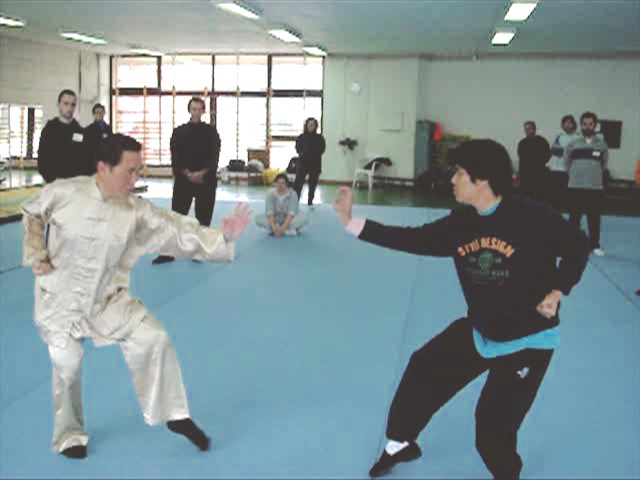 Combat Sequences of Single Tiger Emerges from Cave
The basic 16 combat sequences in our sparring methodology are shortened or distilled into 8 combat sequences shown in this video series. They cover all the four categories of striking, kicking, felling and gripping. These 8 combat sequences are formalized in the set "Single Tiger Emerges from Cave".
A picture series and a video series of this set can be accessed here and here respectively. These 8 combat sequences are structured in the same way as the distilled combat sequences in Wahnam Taijiquan, which are formalized in the Wahnam Taijiquan set, "Yellow Bee Sucks Pollens". Hence, Shaolin and Taijiquan students can use these two sets as basis for their sparring practice.
Click here to enter.
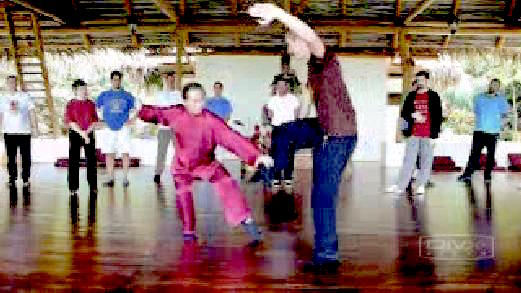 Combat Sequences of Yellow Bee Sucks Pollens
The 12 basic Wahnam Taijiquan combat sequences are compressed or distilled into 8 combat sequences formalized in the set, Yellow Bee Sucks Pollens. This set incorporates a side attack, in the pattern "Yellow Bee Sucks Pollens", not found in the basic 12 combat sequences.
Another advantage is that these 8 Wahnam Taijiquan combat sequences are structured in the same way as the 8 distilled Shaolin combat sequences formalized in the Shaolin set "Single Tiger Emerges from Cave". Therefore, Taijiquan practitioners can conveniently use these 8 combat sequences of "Yellow Bee Sucks Pollens" to train sparring with Shaolin practitioners who know the 8 combat sequences of "Single Tiger Emerges from Cave".
Click here to enter.
Please click on the pictures or their captions to view the videos
 Tantui Combat Sequences -- Hiding Secrets in the Open
Tantui is considered by many as the essence of Northern Shaolin Kungfu. Although our roots in Shaolin Wahnam are in Southern Shaolin, a taste of Northern Shaolin will enhance both our understanding and experience. Tantui is chosen for this purpose because it best manifests the beauty and spirit of Northern Shaolin.
There are literally tens of thousands of people practicing Tantui today. But what is practiced is only the external forms. How to apply Tantui to manifest internal force as well as for combat is almost never taught. Hence, our doing so at the Intensive Shaolin Kungfu courses in Toronto and Frankfurt recently, and at the UK Summer Camp soon will help to preserve and spread this wonderful legacy of our Shaolin arts.
Click here to enter.
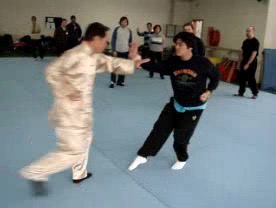 From Combat Sequences to Free Sparring -- Shaolin Kungfu in Portugal, February 2007
Course participants of the regional Shaolin Kungfu course in Portugal in February 2007, including some beginners, were able to apply kungfu patterns for free sparring after just a few days of training. The instructional material was the Eight Simplified Combat Sequences, which form the Shaolin set Single Tiger Emerges from Cave. Similar courses were held in Andorra, Switzerland and Finland.
The video series, recorded at random and released here without editing, are meant to help course participants review their lessons as well as to provide reference material for other Shaolin Wahnam members. Others who wish to use kungfu patterns for combat may find useful material in these videos. While it is unrealistic for them to be able to use kungfu for sparring by merely viewing the videos, the guidelines and examples therein may hopefully be useful to them in their own training.
Click here to enter.
 Sharing Secrets in Combat Application
Understandably not many people may believe that students can learn in just a few days to use typical kungfu patterns for free sparring. But that is true. The video reveal some of the secrets that enable our students to free spar using kungfu patterns.
Naturally, even though the beginning students could free spar using kungfu forms, their combat skills were still low, and they would be easily defeated by experienced martial artists of other styles. But what is certain is that if they spend some time, say a year, practicing what they have learnt at the course, they will be more combat efficient than they would have been had they spent the same period of time in random or free style fighting.
What is more significant is that the Shaolin combat training will contribute to their physical, emotional, mental and spiritual development, whereas randomly punching and kicking one another would be detrimental to their health -- physically, emotionally, mentally and spiritually.
Click here to enter.
 Learning to use Kungfu Patterns in Free Sparring
The reason many kungfu practitioners cannot apply their kungfu patterns for sparring is simply because they have never learnt how to do so. They may have learnt and can perform kungfu patterns in solo very well.
Though it is unreasonable, they presume that if they can perform kungfu patterns in solo, they can use them for combat. This is not true. If you wish to spar well, you have to practice sparring.
Click here to enter.
 Learning the Twelve Taijiquan Combat Sequences
The video clips below show how participants of the 2006 Taijiquan Intensive Course learn the twelve basic Wahnam Taijiquan combat sequences. It will be interesting to compare this video series with the video series showing a review of these 12 basic sequences later in the same year.
Click here to enter.
 Basic Wahnam Taijiquan Combat Sequences
Taijiquan is an internal martial art. By definition, it means that not only is Taijiquan effective for fighting but also that its practitioners use internal force in combat. Hence, Taijiquan practitioners by using internal force can be relaxed yet very powerful while fighting, and they can be fighting for some time without feeling tired or panting for breath.
When many Taiji practitioners today do not even know the combat application of the forms they perform in solo practice, it is understandable that many may find it hard to believe this is possible. But to deride that internal force is fake or that Taijiquan cannot be used for combat is insulting to generations of Taijiquan masters before us, whose manifestations of internal force such as being graceful yet very powerful even at old age and whose combat efficiency using typical Taijiquan patterns are recorded in Taijiquan literature still extant today.
Click here to enter.
 Learning the Combat Sequences for Free Sparring
The secret of the sparring methodology in our school, Shaolin Wahnam, lies in the 16 basic combat sequences taught in the Intensive Shaolin Kungfu Course. A simplified set of 8 combat sequences is derived from these 16 basic sequences, and taught at regional courses.
These 8 combat sequences are complete by themselves, covering all the four categories of attacks and defence, namely striking, kicking, felling and gripping. In other words, without the need to borrow from any other martial arts but by using these 8 combat sequences, a practitioner can adequately defend himself from any forms of attack. Of course he must have the necessary combat skills.
Click here to enter.
 Secrets in Free Sparring Methodology
The secret that enabling participants at the Switzerland Regional Shaolin Kungfu Course of August 2006 to free spar using kungfu techniques is combat sequence training. Other secrets of the sparring methodology include systematic progression and diminishing control. In other words, the participants first used pre-arranged sequences.
Then they were systematically trained to release control gradually so that eventually they could free spar effectively. Of course they must have the pre-requisites of good kungfu techniques and appropriate combat skills.
Click here to enter.
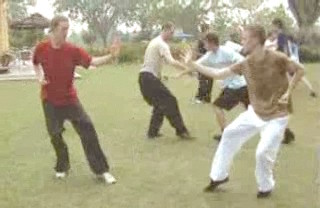 Basic Shaolin Combat Sequences
Listed below are video clips showing the 16 basic combat sequences in our Shaolin Kungfu. They are comprehensive, covering all the four categories of attack and defence, namely striking, kicking, felling, and qin-na (gripping).
It is important to realize that merely knowing the techniques of the combat sequences cannot make you combat efficient. You need to develop combat skills, including, going into correct forms spontaneously, reasonable force and good speed.
Those intending to attend the Intensive Shaolin Kungfu Course should familiarize themselves with these 16 combat sequences. They are the basic material used to develop these combat skills..
Click here to enter.
Please click on the pictures or their captions to view the videos
 Counters against the Shoot -- Part 1
A popular technique used by wrestlers and many other martial artists to take down an opponent is the "Shoot". There are many techniques in kungfu to overcome the Shoot. Here Sifu Wong uses a kungfu pattern called "Heaven Dragon Descends to Earth" to prevent Jamie, an assistant instructor of Shaolin Wahnam Scotland, from a take down.
This kungfu technique, which requries a good stance, is simple and effective, but is applicable if the opponent has not grasped the exponent's legs. If he has held the legs, other techniques would be needed. An example to overcome the Shoot when the legs are already held is given in another video clip.
Click here to enter.
 Counters against the Shoot -- Part 2
There are many counters in kungfu against the Shoot, which is a popular technique used by wrestlers and other martial artists to take down an opponent. Another video clip shows Sifu Wong prevents an opponent from applying the Shoot when he is about to do so.
This video clip shows Sifu Wong uses the kungfu pattern called "Spiritual Dragon Crouches on Ground" to control Jamie, an assistant instructor of Shaolin Wahnam Scotland, who has already grasped both of Sifu Wong's legs for the Shoot. By skillfully sitting down on his Unicorn Stance, Sifu Wong locks Jamie's both hands, while his other two hands are free to strike Jamie.
But even without the hand strikes, the locking of the opponent's arms with the legs can cause much pain at the opponent's elbows. This excellent kungfu technique enables the kungfu exponent to regulate the injury he may or may not want to cause the opponent. He may, for example, dislocate the opponent's elbows, smash the opponent's skull, or just hold him under control with sufficient pain so he will admit defeat.
Click here to enter.
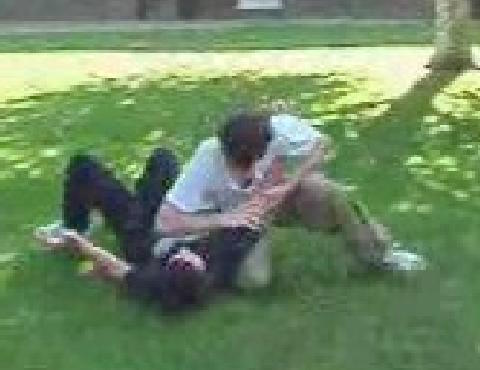 Ground Work in Shaolin Kungfu
It is a common mis-conception that kungfu is poor in ground work. Not only there are some excellent ground work techniques in kungfu, many techniques that are used when standing can also be used when the exponent is on the ground.
During a recess at the Summer Camp in England in July 2005, Sifu Wong asked some assistant instructors how they would overcome some combat situations on the ground. This video clip shows Jamie, an assistant instructor from Shaolin Wahnam Scotland, fell Mark, an assistant instructor from Shaolin Wahnam England, onto the ground and begins to elbow him on his face.
Mark pushes away the elbow attack, uses the pattern "Carb Turns Body" to get up and then controls Jamie with the pattern "Hungry Tiger Returns to Den".
Click here to enter.
 Counter against the Choke
The choke is a popular technique wrestlers and other martial artists use on their opponent when they are on the ground. During a recess at the Summer Camp in England in July 2005, some assistant instructors asked Sifu Wong how a Shaolin practitioner would deal with a choke.
Instead of giving them an answer, Sifu Wong asked them to try out overcoming the combat situation on their own using typical kungfu techniques. To their pleasant surprise they could do so quite readily. This video clip shows an example.
Mark, an assistant instructor of Shaolin Wahnan England, first uses the pattern "Intelligent Monkey Rolls on Ground", then the pattern "Hungry Tiger Returns to Den" to overcome Jamie, an assistant instructor from Shaolin Wahnam Scotland, applying a choke on him.
Click here to enter.
 Combat Sequence Training -- Sequences 5 to 8
It is sad that most kungfu practitioners today cannot apply their kungfu forms for sparring or real fighting. Of course kungfu can be used for fighting, although even some kungfu masters today, ironically, think that it cannot be.
What is the secret to kungfu sparring or fighting? Different schools would have different sparring methodologies. This video clip shows Mark and Simon, both assistant instructors of Shaolin Wahnam England, practicing the fourth step, "Continuation", of this sparring methodology in our school, using Combat Sequences 5 to 8. The movements here are pre-arranged.
Click here to enter.
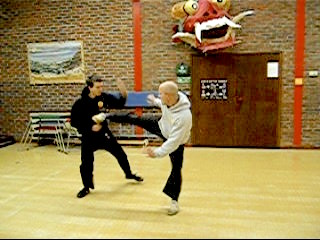 Combat Sequence Training -- Sequences 9 to 12
Some of those who watched Mark and Simon spar in the video clip Combat Sequence Training -- Sequences 5 to 8 may wonder why they did not use any kicks.
The reason was that that combat training session was meant to train hand attacks and defences. Then, how would one defend against kicks? A student at this stage would not be able to do so effectively because he has not been trained yet.
Training in kicking attacks and defences is in the next stage, Combat Sequences 9 to 12, as shown in this video clip. Here, as in the earlier Combat Sequences 5 to 8, all the moves are pre-arranged. Can these students defend themselves if their opponents attack them randomly? Not likely because again they have not been trained yet.
Random attacks and defences will be trained at a later stage. Such stage by stage progression is a key factor in systematic combat training, which will eventually lead to effective free sparring and real fighting. Going straight to free sparring without systematic preparation is a sure way to fight like children.
Click here to enter.
 Miscellaneous Techniques
Practicing miscellaneous techniques, like practicing combat sequences, is a crucial aspect of sparring. The main difference between combat sequences and miscellaneous techniques is that the unit of training in the former is a sequence, whereas that in the latter is an individual technique.
The sequences or techniques used can be pre-arranged or free. The miscellaneous techniques here were demonstrated by Master Ng Kowi Beng and a student about 20 years ago at the University of Science of Malaysia. We are sorry for the poor quality of the video footage, but believe the demonstration is helpful to those who wish to learn using typical kungfu patterns for combat.
Click here to enter.
 Selections from Four Gates Combination Set -- Old Video
This video, taken over 30 years ago in the 1980s, shows some selections from the "Four Gates Combination Set" demonstrated by Kok San and Chee Kong, and also Kok San and Mogan, three of Grandmaster Wong's senior students. However, their demonstrations in this video clip here were performed when they were at their beginning stage of their training, after about a year learning from Sifu Wong.
Combination Set Practice, like Combat Sequence Practice, is a very helpful way towards free sparring. The movements in Combination Set Practice are pre-arranged.
Click here to enter.
 Combat Sequences from Tiger-Crane Set -- Sequence 1
Combat Sequences 1 to 16 provide you with the basis of combat application. In other words, if you are fluent with these sequences, you would be able to handle any forms of striking, kicking, felling and gripping attacks.
Then you can progress to more sophisticated patterns, which you can take from your specialized sets like Tiger-Crane, Five Animals and Dragon Style. This video clip, taken at random during the Special Shaolin Kungfu Course in Toronto in 2003 shows such a transition.
After learning the Tiger-Crane Set, Eugene and David work out between themselves how to apply patterns from the set to overcome various combat situations. As this is the first combat sequence from the specialized set, the combat situations chosen are relatively simple, namely strikes and kicks, and they follow closely the structures of the earlier basic sequences.
David initiates the attacks with patterns from the set, like "Black Tiger Steals Heart" and "Single-Legged Crane", and Eugene responds with patterns like "Black Tiger Emerges from Cave" and "Tame Tiger with Beads". Eugene incorportates a sophisticated pattern, "Hungry Crane Searches for Prawns", and David counters with "False Leg Hand Sweep".
Click here to enter.
 Combat Sequences from Tiger-Crane Set -- Sequence 2
The theme in the combat sequence in this video clip is similar to that in the previous sequence, i.e. using patterns from the Tiger-Crane Set for attack as well as defence in relatively simple combat situations, such as strikes and kicks.
Nevertheless, in this sequence Eugene attacks with "Golden Leopard Speeds through Forest" instead of the typical "Black Tiger Steals Heart", and the "organ-kick" is also more sophisticated as he moves to David's side and employs the tactic of "defence cum counter".
Click here to enter.
Please click on the pictures or their captions to view the videos
 Combat Sequences from Tiger-Crane Set -- Sequence 3
As David and Eugene progress to Sequence 3, their techniques and tactics are more sophisticated though they still keep to relatively simple combat situations of strikes and kicks.
David employs the tactic of "pressing attack", and although Eugene manages to intercept it right from the start by using "Fierce Tiger Descends Mountain", which is an effective response using the tactic of "defence cum counter", David skillfully neutralizes it and continues with his "pressing attacks".
Eugene first thought of using a "hand sweep" to counter David's side kick, but changes his mind and uses "Dark Dragon Wags Tail" instead to tempt the attacker to press on. David probably senses Eugene's trick, but decides to "play" along with it and press on with a "Leopard Punch".
As soon as Eugene responds to it, David turns this attack into a feign move and kicks at Eugene knee instead. Eugene responds with "Single Leg Hand Sweep" and presses back with a level punch.
Click here to enter.
 Sparring Practice at Shaolin Wahnam Switzerland -- Part 1
This is a sparring session at Shaolin Wahnam Switzerland, taught by Sifu Andrew Barnett.
Those who have seen a few of our video clips on sparring may wonder why they look similar, regardless of whether they were taken in Switzerland, Ireland, Canada, Germany, Costa Rica or elsewhere. The answer is straight-forward.
Of course they are similar because they all come from the Shaolin Wahnam Sparring Methodology. In fact this reflects an important point we have been advocating, i.e. those trained in kungfu should spar or fight using kungfu, not using Karate, Kickboxing or any other martial arts.
To go a step deeper, those trained in Shaolin Kungfu or Taijiquan would spar or fight using Shaolin Kungfu or Taijiquan, not using Pak Mei Kungfu or Baguazhang. To go even deeper, those trained in Shaolin Wahnam (whether in Shaolin or Taijiquan) would spar or fight using the skills and techniques learnt in Shaolin Wahnam.
This leads to another question. Can those trained in other schools or systems benefit from watching video clips on Shaolin Wahnam Sparring Methodolgy? Of course they can. They may, for example, apply the principles explained or shown on our video clips to their own styles or systems.
They may, for example, learn how to use their own techniques for defence, instead of merely punching and kicking wildly. The principles are the same, but the sparring will be different because they use the techniques of their own schools or systems.
Click here to enter.
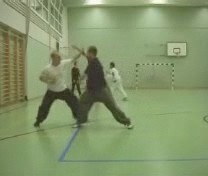 Transition from Pre-Arranged to Free Sparring -- Part 2
Here is another sparring session at Shaolin Wahnam Switzerland. Interestingly, this impromptu video clip filmed during a regular class taught by Sifu Andrew Barnett, exemplifies a fact that many kungfu students may have read but find it hard to believe, namely a master with internal force may floor an attacker simply by warding off his attack.
At the start of the video clip, a female student attacks Sifu Andrew Barnett with "Black Tiger Steals Heart". Sifu Andrew Barnett responds with "Dark Dragon Draws Water", which is found in Sequence 6 of our Shaolin Wahnam Sparring Methodolgy. Although Sifu Andrew Barnett controls his attack, the attacker falls onto the ground, not due to his attack but due to the force of his other defending hand, albeit purposely reduced under his control.
The sparring shown in this video clip is similar to that shown in other video clips. This is because the practitioners train the same type of kungfu and employ the same sparring methodology. In other words, anyone using the Shaolin Wahnam Sparring Methodolgy correctly would be able to spar like those shown in the video clips, i.e. using typical kungfu techniques and skills -- and not using Kickboxing techniques or bouncing about like Boxers.
Similarly anyone using an appropriate sparring methodology in Taijiquan, Hoong Ka, Wing Choon, Praying Mantis or any kungfu style would be able to spar and fight using his own style. Such sparring methodologies were used in the past, but today they are extremely rare. So if you wish to spar using your own kungfu style, you have to find out an appropriate sparring methodology, or, albeit a poor alternative, work one out yourself. Hopefully, our video clips will provide you with some help.
Click here to enter.
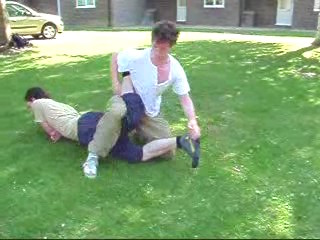 Zhang Kuo Lao Riding a Donkey the Reverse Way
Sifu Wong posted some combat questions which he had received from a reader of his Question-Answer Series, to some assistant instructors at the Summer Camp in England in July 2005 to test their understanding of combat application. The assistant instructors overcame the situations promptly.
Here Jamie of Shaolin Wahnam Scotland demonstrates how he overcomes an arm cum body lock on the ground by using the pattern "Zhang Kuo Lao Riding a Donkey the Reverse Way". (Zhang Kuo Lao is the most senior of the Taoist Eight Immortals.)
Click here to enter.
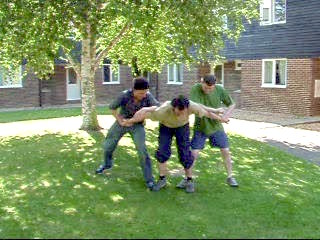 Black Crow Folds Wings
Two opponents hold your arms at both side, threatening to break your elbows. What would you do? This is a question Sifu Wong received from a reader of the Question-Answer Series, and which he posted to some assistant instructors at the Summer Camp in England in July 2005.
Here Innes of Shaolin Wahnam Scotland demonstrates how he overcomes the situation using the Shaolin pattern "Black Crow Flaps Wings". Some internal force is needed for this application.
As Innes is big in size, some people may have the mis-conception that being big in size is necessary for this counter. So Sifu Wong asked Hubert, who is smaller in size, to demonstrate overcoming the same situation. Hubert uses another pattern, "Big Bird Spreads Wings". You can view Hubert's application here.
Click here to enter.
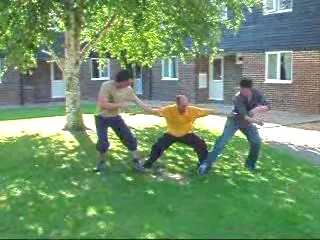 Big Bird Spreads Wings
At the Summer Camp in England in July 2005, Sifu Wong asked some assistant instructors how they would overcome some combat situations posted by a reader of the Question-Answer Series. In another video clip Innes demonstrates how to release his two arms from being held by two opponents.
As Innes is big in size, Sifu Wong said that this might give a false impression to some people that his successful counter was due to his muscular strength. So he asked Hubert, who is smaller in size, to demonstrate his technique against the same counter. Here Hubert from Shaolin Wahnam England uses the pattern "Big Bird Spreads Wings" to release the hold on his two arms by two bigger size opponents
Click here to enter.
 Tan Tui or Spring-Kicks (Part 1)
"Tan Tui" (pronounced like "th'an th'ui") or "Spring-Kicks" is a well-known style of Northern Shaolin Kungfu famous for its kicks.
After a training session during the Shaolin Review Course in December 2004 in Malaysia, Michael Chow from Shaolin Wahnam Canada who has won a few medals in international wushu competitions, asks Sifu Wong the combat applications of some Tan Tui techniques.
Sifu Wong explains that the strength of Tan Tui lies in its sequences rather than in its patterns, where a practitioner can attack an opponent using an appropriate sequence often without regardless of the opponent's responses! First Sifu Wong asks Michael to demonstrate a Tan Tui sequence. Then he explains its combat application.
Click here to enter.
 Tan Tui or Spring-Kicks (Part 2)
Though many martial artists may find it hard to believe, it is true that if a Tan Tui exponent is skilful he can apply a sequence from the "Twelve Sequences of Tan Tui" to attack an opponent almost irrespective of how the opponent responses!
This principle of sequence attack may also be true in all other kungfu styles, but it is in Tan Tui that this tactic is most applicable. It is not without good reasons that Tai Tui is sometimes regarded as the "essence of Northern Shaolin".
Sifu Wong shows Michael Chow of Shaolin Wahnam Canada an example of how to use a sequence from Tan Tui to implement this tactic of pressing attack
Click here to enter.
 Tan Tui or Spring-Kicks (Part 3)
A Tan Tui sequence is formidable only when its exponent is fluent and skilful in the individual patterns that constitute the sequence. Hence, Sifu Wong explains to Michael Chow the numerous applications of the pattern "Block Hand Thrust Punch" (known as "Lift Pot Offer Wine" in Southern Shaolin, and "Double Bows Tame Tiger" in Taijiquan) found in a sequence.
For example, irrespective of whether an opponent attacks with an upper chop or a hand grip, the Tan Tui exponent can apply "Block Hand Thrust Punch". As soon as the opponent wards off the thrust punch and almost irrespective of how he counter-attacks, the Tan Tui exponent can immediately follow up with "Hang Fist Thrust Kick". The Tan Tui techniques are simple but their combat applications are profound.
Click here to enter.
Please click on the pictures or their captions to view the videos
 Northern Shaolin Long Fist (Part 1)
"Chang Quan" which is often literally translated as "Long Fist" is a generic name for many Northern Shaolin kungfu styles as well as Northern Shaolin kungfu sets. For example, Chaquan and Baoquan, two famous Northern Shaolin styles, are classified as "long fists". "Mother-Child" and "Open Gate Cannon", which are the two fundamental kungfu sets of Chaquan and Baoquan respectively, can also be referred to as "long fists".
In this video clip Sifu Wong demonstrates to Michael Chow, who has won gold medals in international "Long Fist" competitions, some combat applications of typical "Long Fist" techniques. To show that the "Long Fist" technique of "Throwing Hand" can be used to fell a heavy opponent, Sifu Wong demonstrates it on David Ko, another international wushu gold medalist.
Click here to enter.
 Northern Shaolin Long Fist (Part 2)
"Chang Quan" or "Long Fist" is the first of the seven categories of wushu established by modern China. The crucial difference between wushu, which is a demonstrative sport, and kungfu, which is a fighting art, is not in their forms or appearances.
Indeed wushu forms and kungfu forms are similar. The crucial difference is in their application. If we can apply wushu forms for combat, especially with internal force, wushu may become high level kungfu.
Please note that while we at Shaolin Wahnam practice kungfu, we have much respect for wushu too, knowing very well that wushu practitioners spend much time perfecting their art, and we are very proud of the many wushu gold medalists in our midst.
Here Sifu Wong shows Michael Chow, an international wushu medalist, how to apply Long Fist techniques for combat. The main technique shown here is known as "Separate Fists", called "Cross-Hand Separate Gold" in Shaolin and "Big Opening" in Taijiquan. Among many other applications, it is an effective counter against an opponent charging in with a "shoot" or "take-down".
Click here to enter.
LINKS